

Stolen Credibility
The Deepfake Challenge

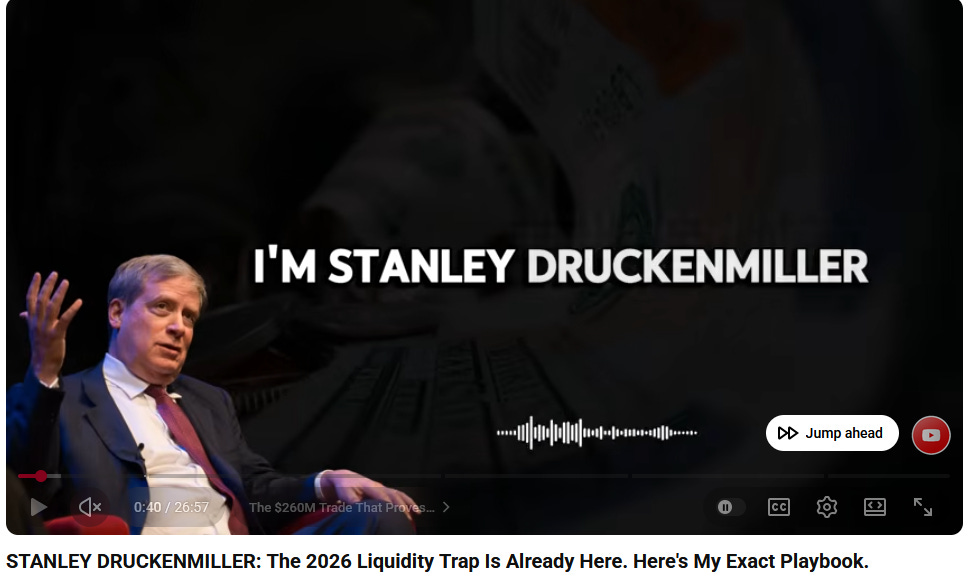
In early February 2026, I watched a YouTube video revealing billionaire investor Stanley Druckenmiller’s “exact playbook” for navigating an impending market crash. Druckenmiller, one of the most successful macro investors of the past half-century, was warning about $38 trillion in federal debt, Federal Reserve liquidity withdrawal, and the overvaluation of technology stocks. The forecast was specific: a 30–40% market decline by fall 2026.
The video detailed his supposed defensive positioning—35% cash, gold-mining stocks, and Nasdaq puts (QQQ). Roughly 160,000 other viewers watched it.
It was entirely fabricated. The voice was AI-generated. The script was synthetic. The authority was borrowed.
Verification
A check of Duquesne Capital’s Q4 2025 13F filing (submitted mid-February 2026) tells a very different story. The filing disclosed roughly $4.5 billion in long U.S. equity positions, including holdings in biotech names such as Natera and Insmed, exposure to financials through XLF, positions in the equal-weight S&P 500 (RSP), Brazil (EWZ), Alcoa, airlines, and increased exposure to large technology companies such as Alphabet and Amazon.
A 13F does not disclose cash balances, short positions, or derivatives. But it does reveal a manager’s long U.S. equity exposures. Whatever one thinks of those positions, they are not a 35% cash-and-gold defensive posture.
Two clicks down in the video description, a disclaimer appeared: “Fan-made educational content. Not affiliated with Stanley Druckenmiller or Duquesne Capital. AI-generated voices. Not financial advice.” This legal hedge was buried. The impersonation was not. On screen, the voice declared: “I’m Stanley Druckenmiller.”
The Pattern
This is not an isolated incident. In late 2025, Berkshire Hathaway issued a public warning about AI-generated videos impersonating Warren Buffett. Elon Musk has been repeatedly deepfaked in thousands of scam advertisements promoting fraudulent crypto or trading platforms. Ray Dalio, Jeff Bezos, and UK financial commentator Martin Lewis have appeared in fabricated interviews endorsing nonexistent schemes.
The format is consistent: confident tone, macro warnings, precise predictions, specific allocations. The production quality is high. The emotional trigger is fear or FOMO. The sophisticated investor was never the target. The marginal viewer was.
The Economics
The economics of cost and revenue explain the proliferation. A script can be generated by ChatGPT or Claude. Voices can be cloned using services such as ElevenLabs. Editing can be done with inexpensive tools like CapCut or InVideo. The total cost can be under ten dollars. A 30-minute video can be assembled in a few hours by a single operator or a small team.
Finance content commands relatively high advertising rates. Depending on the category, a 100,000-view video can generate several thousand dollars in ad revenue before affiliate commissions. Multiply this across channels and iterations, and the model scales.
YouTube requires disclosure of certain AI-generated content and can demonetize deceptive videos. But enforcement is uneven and largely reactive. The creators remain anonymous unless compelled by court order. The risk is low. The margins are attractive. Thus, supply grows.
The Structural Shift
Most commentary on this focuses on deception: a famous investor was impersonated, and viewers were misled. Platforms should respond. But that framing misses the deeper shift.
For decades, credibility in the finance function was a costly signal. It required a track record, capital at risk, institutional oversight, reputational exposure, and the possibility of legal liability. Those costs constrained supply. They created scarcity. Authority was difficult to manufacture and expensive to sustain.
Now the appearance of that authority can be produced for the price of a sandwich. This is not merely a technological curiosity. It is a collapse in the cost structure of persuasion.
When the cost of computing fell, entire industries were reorganized. When the cost of publishing fell to near zero, editorial gatekeeping lost its function as a barrier to entry. When newspapers lost their advertising revenue stream to Google, they lost their editorial independence. Today, the cost of manufacturing a credible-seeming financial authority has dropped to near zero. When a key input cost collapses, entry barriers fall. Supply explodes. Quality variance widens. The signal-to-noise ratio deteriorates.
The Consequence
No single deepfake video will crash markets. But the information environment in which financial decisions are made has shifted. Authentic commentary must now compete with unlimited synthetic authority—indistinguishable in voice, tone, and visual polish to the casual observer.
Paradoxically, genuine credibility may become more valuable in such an environment. Transparent reasoning, verifiable track records, institutional accountability, and primary-source disclosure may command a premium precisely because synthetic substitutes are everywhere.
But that premium will not arise automatically. The cost of manufacturing credibility has collapsed. By contrast, the cost of discernment has not. So, the burden has shifted—from institutions to audiences. And 160,000 viewers just learned how cheap authority has become.
Great example. The scams get more subtle in this new AI-focused world. Just run into another one, with no disclaimer this time:
THE HIDDEN TRAP OF GPTs
https://lnkd.in/dkEwGkNK
The crux of the matter: "The risk is low. The margins are attractive. Thus, supply grows." This applies to YouTube deep fakes as well as entire channels on YouTube that mix AI-scripts on popular topics (e.g. car mechanics) and mash-ups of stock video footage that, given the volume of footage cuts, seem to support the script. There are now channels with hundreds of thousands of subscribers that only feature this kind of content.
The monetary incentive to do this on YouTube ensures the AI-made content will continue. Off YouTube, there are even greater problems. Attention is the inelastic, scarce resource, and there are many benefits to getting as much attention as possible. Those benefits are driving the proliferation of spam across the Internet and across all types of content.
For example, written content, as with social media posts (and replies to posts), costs only the effort of a prompt, a copy/paste. Platforms defer to the community to filter content, again leading to a low-risk for the AI-powered spammer with a lot of upside. Networks of AI-powered spammers, too, can work to influence algorithms which seem inadequate (or the teams behind the algos uninterested) in policing these bad behaviors.
Whatever the case, the asymmetry here, which you allude to "The cost of manufacturing credibility has collapsed. By contrast, the cost of discernment has not. So, the burden has shifted—from institutions to audiences," is the guarantee that AI-powered content very well may propagate until such a time that that a bankruptcy is declared. With "fiat content," could it be any other way?
The hyperinflation of content is coming, if it's not here already: https://blog.unaiify.com/p/the-hyperinflation-of-content