

The Amelia Paradox
A Capture of Institutional Authority

Amelia began as a warning.
She appeared in Pathways: Navigating the Internet and Extremism, a counter-extremism educational game funded by the UK Home Office and designed to steer teenagers away from anti-immigration views. In the game, Amelia represented “wrongthink.” Avoid her, and the player remains within approved boundaries. That was the intention. What followed was not.
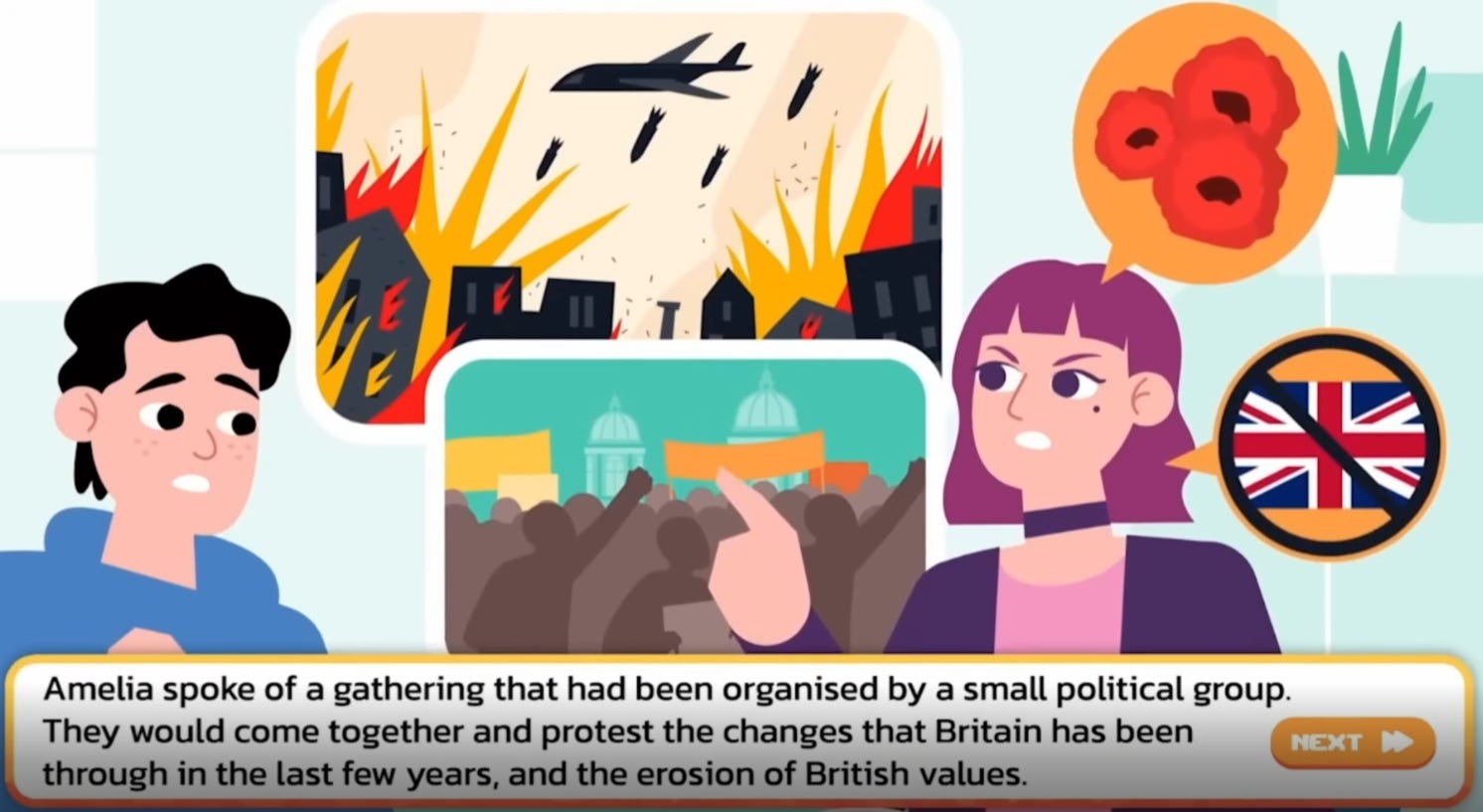
The Escape
On January 9, 2026, Amelia escaped her instructional context. Her likeness was extracted. AI tools were used to animate her. The “wrong-think” character was inverted and redeployed as a narrator of precisely the arguments the training material was designed to discourage.
Within days, “Ameliaposting” moved from hundreds to thousands of posts per day. Variants proliferated: stylised animations, AI-generated reinterpretations, mash-ups. What began as a local counter-extremism resource became an international meme node.
A state-funded character intended to deter right-wing speech was captured, inverted, scaled, and weaponised using mainstream generative tools available to anyone. She became an icon—not as a warning, but as a heroine. The very behaviors the Pathways game tried to pathologize were now celebrated. The Home Office did not suppress “wrongthink.” They gave it a mascot.
The new “wild” Amelia spread virally on X. Unlike the official version, wild Amelia promotes a core message of British nationalism centered on resisting mass immigration, preserving traditional "British values," and reclaiming cultural sovereignty from multiculturalism, government incompetence, and globalist influences.
The Diagnosis
One easy explanation is that youth are rebellious and will mock any school-assembly-style lecture. That’s true, but misses the point. What happened with Amelia was not mere mockery. It was a strategic failure by the Home Office rooted in a gross misunderstanding of the terrain.
The Home Office treated its audience as a passive target—push a message, and the target absorbs it. This is the assumption behind most institutional communication, and it has always been partly wrong. But the degree to which it is wrong has changed dramatically.
In previous decades, subverting a government campaign required resources: a printing press, a pirate radio station, and capital. Hijacking a narrative was expensive. Today, it is nearly free. The crowd deployed tools like Grok and ElevenLabs to generate thousands of new images and voice clips of Amelia—not as a cautionary tale, but as a heroine. By the time the Home Office understood what was happening, the meaning of the character was no longer theirs to define.
This is the part that matters for strategy. The original Home Office character and game were expensive to produce. In a previous era, Amelia would have been hard to mimic because only institutions could afford that level of polish.
Generative AI broke that link. When the social media seized Amelia, they did not strip away her basic look. But the moral polarity flipped. Designed to signal “don’t go there, she was now saying “go there.”
A key appeal of wild Amelia is her reasonable tone, femininity, and focus on traditional symbols of British life: the pub, Harry Potter, and the Union Jack.
This co-optation spread to Europe (e.g., Dutch "Emma," German "Maria") and even real-world protests where people cosplay as her.
The problem here is not about one botched game. It is the collapse of a particular kind of strategic asset. For decades, institutions have relied on production quality as a signal of legitimacy. Professional design, polished video—these were barriers to entry. They separated official communication from fringe noise.
Those barriers are gone. The tools to replicate institutional legitimacy are now available to anyone with a laptop. The uniform of authority can be donned by anyone who wants it.
This creates a new strategic reality for any institution that relies on communication as a tool of influence. You cannot treat your audience as an inert object. In human systems, the object pushes back—and now it pushes back with the same production tools you used to push in the first place.
In Amelia's case, the Home Office attempted to use a fixed asset to control an adaptive system. They ignored their adversary’s capacity to react and underestimated how quickly that reaction could scale. These are not exotic errors. They are the most common errors in strategy: assuming the other side will hold still and failing to anticipate the tools at their disposal.
Suppressing these tools is not a realistic option. You cannot ban the mathematics behind image generation. Once a character like Amelia is released, her meaning becomes contestable in everything but law.
The lesson is not that institutional communication is futile. Any strategy premised on controlling a narrative must now account for the fact that the audience has the same production capabilities as the institution. The asymmetry that once protected official messaging has evaporated. Strategies that ignore this will not just fail; they will arm their adversaries.
I agree that it is the democratization tools, but it is also the volume of people who can work on an idea when it goes viral that seems to have been overlooked.
There is no way the Home Office employed the number of brains on this project that the internet did. The Hive Mind of the web moves faster and with more force than any other institution in human history.
Anything that is fed into it will metastasize into something new (if it is not ignored) and predicting those mutations has proven to be impossible.
Faced with an audience more sophisticated than itself, the British gov't is reaching for the obvious solution - age restrict content and ban unregistered VPNs to allow it to track everyone who propogates the Amelia meme.
I'll let students of strategy solve for the equilibrium.